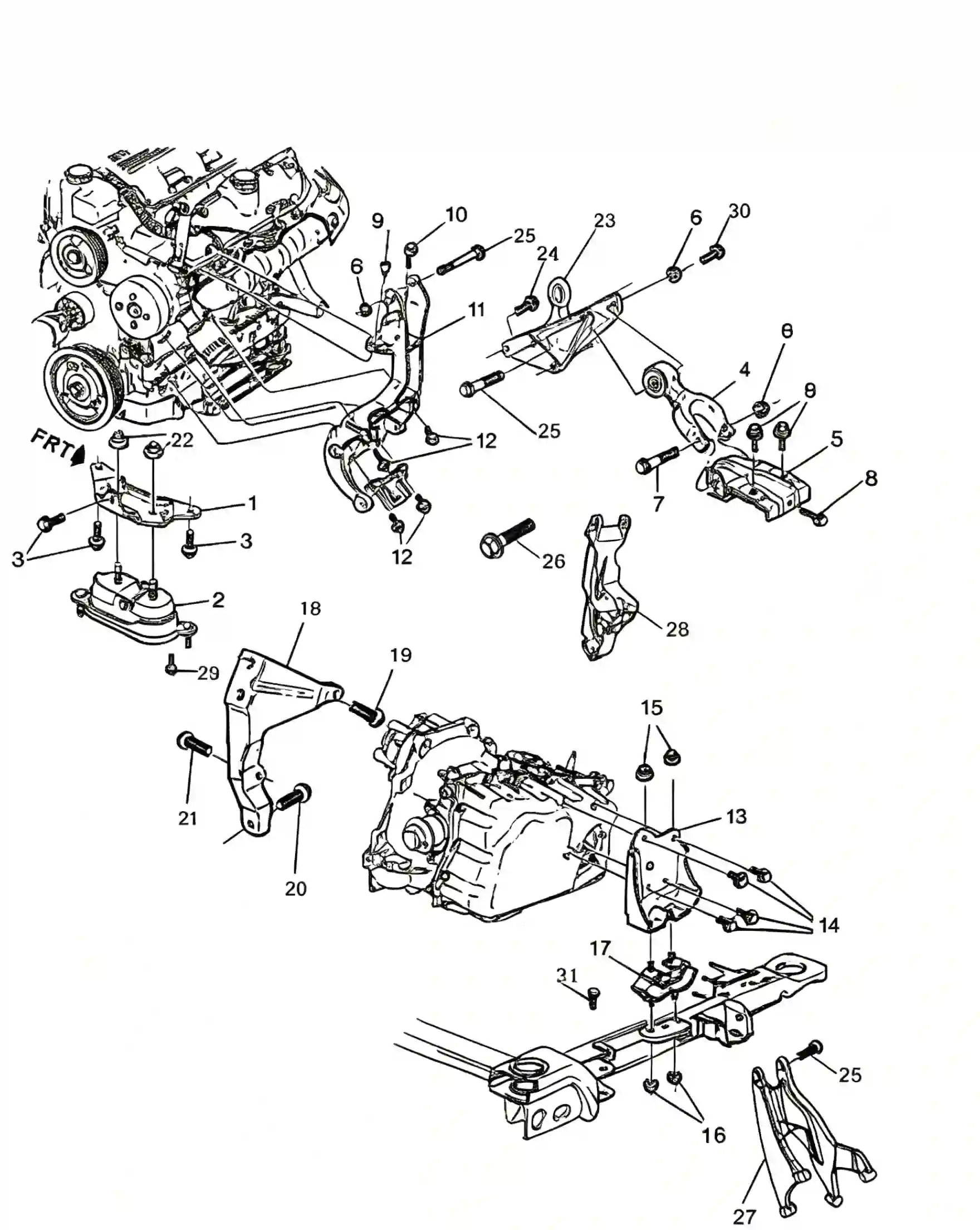
Core overview: The basic framework of the engine structure
The complete architecture of a fuel engine for a family car follows industry standards: two motion mechanisms + five auxiliary systems.
The two mechanisms are responsible for energy conversion and power output, and are the core framework of the engine; the five systems are responsible for supply, lubrication, temperature control, ignition, and ventilation.
1. Engine assembly (Energy Conversion Core)
As the power heart of the vehicle, the engine converts the thermal energy from fuel combustion into mechanical power through the reciprocating motion of pistons and the transmission of the crankshaft. The engine displacement, cylinder number, and intake form (natural aspiration/turbocharging) directly determine the upper limit of power output and fuel efficiency. Common issues such as idle vibration, power loss, and soaring fuel consumption are essentially caused by the decline in energy conversion efficiency due to carbon deposits in the combustion chamber, aging seals, and imbalance in operating conditions.
2. Transmission assembly (Power Matching Hub)
It is not merely a “gear shifting device”. Its core function is to match the engine speed with the vehicle’s wheel conditions. Through gear shifting and torque variation, it addresses the issue of uneven power output of the engine at different speeds, ensuring that the vehicle operates optimally during starting, acceleration, and constant speed driving. Manual transmissions rely on mechanical transmission, while automatic, CVT, and dual-clutch transmissions focus on intelligent power distribution. Jolts, abnormal noises, and delayed gear shifting are all caused by abnormal matching of the transmission’s transmission structure or control program.
3. Fuel Supply System (Power Supply Foundation)
It includes fuel pumps, fuel injectors, fuel filters, and fuel pipelines, forming a closed-loop fuel supply system. The fuel filter is responsible for filtering impurities in the fuel, while the fuel injector controls the fuel atomization accuracy, which directly affects the combustion efficiency. Failure to replace the filter regularly or using poor-quality fuel will lead to clogging of the fuel injector and accumulation of carbon deposits in the cylinder, resulting in a vicious cycle of “insufficient fuel supply → insufficient combustion → reduced power → increased fuel consumption”..
4. Intake and Exhaust System (Condition Balance Guarantee)
The intake manifold and air filter supply sufficient and clean air to ensure complete fuel combustion; the three-way catalytic converter is responsible for purifying exhaust gases and filtering harmful substances, adapting to emission standards; the muffler optimizes the exhaust frequency and reduces operating noise. Blockage of the intake or poor exhaust flow will directly cause engine stalling, restricted power, and exhaust gas during annual inspection.